

What is selective licensing?
Selective Licensing was introduced by the Housing Act 2004. It allows local housing authorities to designate selective licensing areas in neighbourhoods if the area is experiencing one or more of the following conditions:
- Low housing demand (or is likely to become such an area)
- A significant and persistent problem caused by antisocial behaviour
- Poor property condition
- High levels of migration
- High level of deprivation
- High levels of crime
A designation area can be in force for a maximum of five years. Within a designation area all privately rented properties (subject to legislative exemptions) require a licence to operate. The owner of the rented property will need to make an application to the council for a licence. The licence is valid for a maximum of 5 years unless revoked, and contains a series of conditions that the licence holder must meet. To breach the licence conditions is a criminal offence, as is the failure to apply for a licence, which could lead to a prosecution with an unlimited fine or a maximum civil penalty of £40,000.
Where are the current selective licensing areas in Burnley?
Burnley Wood with Healey Wood, and the Leyland Road areas:
21st July 2022 – 20th July 2027
Gannow, Trinity, Queensgate, Padiham, Daneshouse areas: 27th April 2025 – 26th April 2030
Why has the council introduced selective licensing in Burnley?
Some areas of the borough continue to experience low demand for housing and poor housing conditions, meaning that fewer people choose to live there. These neighbourhoods often have higher numbers of empty properties, poorer housing conditions, lower property values, and higher levels of crime and anti-social behaviour.
The Council and its partners are investing in a range of regeneration projects to help improve these areas and support economic growth. However, attracting more people to live in these neighbourhoods also depends on providing good-quality homes that meet residents’ needs and expectations. Improving housing standards and ensuring properties are well managed can help make these areas more attractive places to live, increasing demand for housing and supporting wider regeneration objectives.
In these areas, the private rented sector often contributes to existing problems such as low housing demand and poor housing conditions. Poorly maintained and badly managed rented properties can make neighbourhoods less attractive, discouraging people from moving to or remaining in the area. While many landlords in Burnley provide good-quality homes and manage their properties responsibly, parts of the private rented sector continue to suffer from a reputation for poor standards and inadequate management.
The Council wants to work with landlords, tenants and managing agents to improve both the quality and reputation of the private rented sector, helping to make it a tenure of choice. Selective Licensing helps achieve this by requiring landlords to engage with the Council and meet minimum property and management standards. It encourages landlords to manage their properties effectively and take appropriate action when tenants breach their tenancy agreements, helping to prevent problems from escalating and affecting neighbours and the wider community.
Does the authority intend to roll out the scheme across the whole town?
There are no plans to implement the scheme across the whole town.
The current schemes of Burnley Wood with Healey Wood and the Leyland Road areas are due to end on 20th July 2027 with Gannow,Trinity,Queensgate, Padiham, Daneshouse areas due to end 26th April 2030.
The Council is currently going through a consultation period from 3rd August until the 18th October 2026 to get your views on redesignating the Burnley Wood with Healey Wood area and Leyland Road area and introducing a new selective licensing area in the Lyndhurst Road area.
What is the point of responding to the consultation? The areas will be designated no matter what I say.
Every response received by the Council is included in a consultation report that is presented to the Executive Committee for consideration. Feedback received during previous consultations has directly influenced the design of Selective Licensing schemes. For example, comments from landlords led to the introduction of a higher discount for accredited landlords and more flexible arrangements, allowing licence fees to be paid over a longer period. This demonstrates that consultation responses are carefully considered and can help shape the final proposals.
Does the council have to apply to the Secretary of State for approval of the selective licensing areas?
No . With effect from 23 December 2024 a new General Approval came into force which now means local housing authorities in England are no longer required to obtain confirmation from the Secretary of State before implementing a selective licensing scheme of any size.
However, before introducing a Selective Licensing scheme, the Council must meet all of the legal requirements set out in Part 3 of the Housing Act 2004. As part of this process, the Council is also required to carry out a public consultation on the proposed designation for a minimum period of 10 weeks.
The consultation gives landlords, tenants, residents, businesses and other interested parties the opportunity to comment on the proposals before any decision is made. The Council must consider all responses received as part of the decision-making process.
Other councils have stopped doing selective licensing
Every council has their own strategies/policies and procedures to address specific conditions within their own area. Many Councils continue to use selective licensing within their private rented sector.
How long does a selective license last?
For a maximum of 5 years; but can be revoked, for example if the licence holder has sold the property or no longer meets the Fit and Proper standard.
Is a selective license transferable to another property or person?
The legislation governing Selective Licensing does not allow a licence to be transferred from one person to another. If ownership, management, or control of a property changes, the existing licence cannot be passed on to the new owner or manager. Instead, the new person responsible for the property must apply for a new licence if the property remains within a designated Selective Licensing area.
I have properties in different local authorities….. do I have to apply to each of them?
Yes, if your property is in a selective licensing area you must apply to the local authority where the property is located for each licence.
Will selective licensing tackle rogue landlords?
The Council has robust processes in place to identify landlords and managing agents who fail to apply for a licence when one is required. Where landlords do not comply, the Council may take enforcement action, including issuing financial penalties, prosecuting offenders, applying for Rent Repayment Orders, and, where appropriate, seeking Management Orders to ensure properties are properly managed.
The Council will also refuse licence applications from landlords or managing agents who cannot demonstrate that they are fit and proper persons or that suitable management arrangements are in place for the property. This helps to ensure that privately rented homes are managed responsibly and meet the standards expected within the borough.
Can the council refuse to license my property?
Yes. If the licence holder or managing agent does not meet the Council’s Fit and Proper Person requirements or cannot demonstrate that suitable management arrangements are in place, the Council may refuse to grant a licence.
Where a licence cannot be granted and there is no realistic prospect of the property becoming compliant, the Council can make an Interim Management Order (IMO). This gives the Council the power to take over the management of the property to ensure it is properly managed and that tenants are protected.
Under an Interim Management Order, the Council can carry out necessary repairs and maintenance, collect rent from tenants, and deal with the day-to-day management of the property until suitable long-term arrangements can be put in place.
Can I appeal against the decision?
You may appeal to the First-tier of the Property Chamber, usually within 28 days.
What does ‘fit and proper person’ mean?
The application form for the licence will be checked to determine whether;
- The proposed Licence Holder is a fit and proper (“Fit and Proper”) person to be the Licence Holder, and is, out of all the persons reasonably available to be the Licence Holder in respect of the house, the most appropriate person to be the Licence Holder;
- The proposed Manager of the house is either – the person having control of the house, or a person who is an agent or employee of the person having control of the house;
- That the proposed Manager is a fit and proper person to be the Manager,
- That the proposed Property Management Arrangements for the house are satisfactory.
- All persons involved in the management of the property are to be identified and assessed under the Fit and Proper person criteria.
“Fit and Proper” means that that the person is morally suitable in terms of integrity, honesty and reputation and without significant convictions. For further information the Fit and Proper person and Management Arrangement Criteria for selective licensing are detailed on the Council’s website. The Council recommends reading the Fit-and-Proper-Criteria.pdf prior to making an application.
What happens if a landlord fails to apply for a licence?
It is against the law to rent out a property in a Selective Licensing area without applying for the required licence. A landlord who is found guilty of doing so can face an unlimited fine and may receive a criminal conviction.
The Council can also apply for a Rent Repayment Order, which requires the landlord to repay rent received during the period when the property should have been licensed.
As an alternative to prosecution, the Council may issue a Civil Penalty Notice. These financial penalties can be substantial, with a maximum penalty of up to £40,000 for certain housing offences. These powers help ensure that landlords comply with their legal responsibilities and contribute to improving standards across the private rented sector.
How will landlord licensing benefit landlords?
Selective Licensing helps to set clear minimum standards for the management and condition of privately rented properties within a designated area. As part of the licensing process, landlords must demonstrate that they meet these standards and can manage their properties effectively. Landlords whose management practices fall below the required standard will be expected to make improvements before a licence can be granted. This helps ensure that all landlords are working to the same minimum standards, creating a fair and level playing field for everyone operating in the private rented sector.
Landlords or managing agents who refuse to meet these standards may be refused a licence and could face enforcement action, including prosecution if they continue to operate unlawfully. This helps prevent poorly performing landlords from undermining responsible landlords and contributes to raising standards across the area for the benefit of tenants and local communities.
By tackling poor property management and taking action against rogue landlords, the Council aims to improve standards across the private rented sector. This helps create a more professional, well-managed and stable rental market, which in turn supports stronger and more sustainable communities.
The Council uses a range of monitoring and enforcement activities to identify landlords who are failing to comply with licence conditions or who are operating without the required licence. Regular area inspections are also carried out to identify properties in poor condition and address environmental issues such as dirty back yards, fly-tipping and poor waste management practices. Responsible landlords are supported through advice, training and guidance provided by the Selective Licensing Team and through landlord training events. The team can also assist landlords with tenant referencing and provide information relating to anti-social behaviour or criminal activity where appropriate.
In addition, the Selective Licensing Team acts as a single point of contact within the Council for landlords operating in designated areas, providing advice and helping landlords access the services and support they may need to manage their properties effectively.
Are there conditions attached to the licence?
There are certain conditions that the Council is required by law to include in every Selective Licence. For example, landlords must ensure that appropriate smoke alarms and carbon monoxide alarms are installed in their properties and they have a valid Gas Safety Certification.
In addition to these mandatory conditions, the Council may include further licence conditions where it considers them necessary to ensure that a property is properly managed.
Will the scheme be effective in practice?
Through a coordinated approach involving the Council and its partner agencies, areas that have previously been subject to Selective Licensing have seen positive improvements. These include better property management, improved housing conditions, and progress in addressing issues that can affect the quality of life for local residents.
However, despite these improvements, the designated areas continue to experience higher levels of deprivation and poorer housing conditions than many other parts of the borough. This demonstrates that, while progress has been made, there is still a need for continued intervention and support to further improve housing standards, strengthen communities, and make these neighbourhoods more attractive places to live.
Isn’t selective licensing just a tax on good landlords?
Selective licensing forms a key part of Burnley’s wider regeneration programme, which aims to attract new residents to the borough and encourage business investment. The quality and management of the private rented sector play a significant role in achieving these objectives. Poor-quality housing and property management can undermine neighbourhood appeal, discourage inward investment, and deter people from moving to or remaining in an area. While many landlords in Burnley operate responsibly and provide good-quality accommodation, the private rented sector continues to be associated with poor housing conditions and management practices in some areas. Selective licensing seeks to address these issues, improve housing standards, and support the development of sustainable and attractive communities.
Working in partnership with landlords, tenants, and managing agents, the Council is committed to improving both the quality of the private rented sector and its reputation, with the aim of making private renting a tenure of choice. A range of initiatives are already in place to support this objective, including landlord forums, engagement events, and the Burnley Good Landlord Accreditation Scheme. However, experience has shown that a significant proportion of landlords do not engage voluntarily with these initiatives. Selective Licensing provides a mechanism to ensure that all landlords engage with the Council and meet appropriate property and tenancy management standards. It enables the Council to work proactively with landlords to improve management practices and, where necessary, take action to address breaches of licence conditions or tenancy-related issues before they have a detrimental impact on tenants, neighbouring residents, or the wider community.
The legislation governing Selective Licensing does not allow the Council to target only those landlords who fail to meet their responsibilities. Instead, designation applies to a defined geographical area, requiring all landlords who let privately rented properties within that area to obtain a licence. This ensures a consistent approach to improving standards across the sector and creates a level playing field for responsible landlords.
To recognise landlords who already meet the required legal and management standards, the Council has incorporated an incentive within the licensing scheme. Landlords who are existing members of the Good Landlord and Agent Scheme will be eligible for a 30% discount on Part B of the licence fee. This reduction acknowledges their commitment to maintaining high standards of property and tenancy management.
To qualify for the discount, a landlord must have applied to join GLAS before the Selective Licensing designation comes into effect and must subsequently achieve accredited status. This approach supports and rewards responsible landlords while encouraging wider participation in accreditation and the continuous improvement of standards within Burnley’s private rented sector.
How much will the fee be?
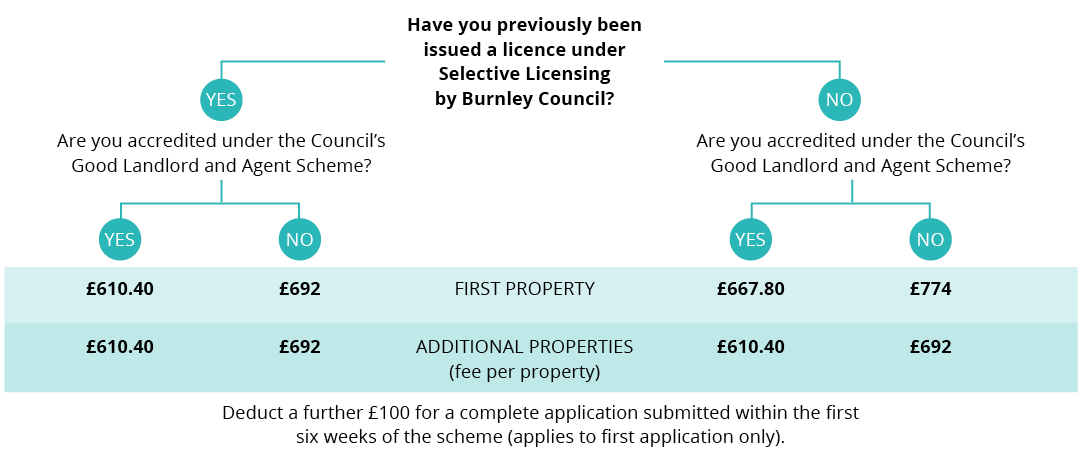
The fee covers the implementation and monitoring of the scheme, including support and information for landlords.
Fees for properties in the proposed Burnley Wood with Healey wood, Leyland Road and Lyndhurst Road areas:
The licence fee covers the costs associated with a five-year Selective Licensing designation. In recognition of landlords and managing agents who already demonstrate a commitment to good property and tenancy management standards, a 30% discount on Part B of the licence fee will be available to members of the Good Landlord and Agent Scheme (GLAS).
In addition, to encourage compliance and engagement with the licensing scheme, landlords in the designated areas who submit their first licence application within six weeks of their property becoming subject to licensing will be eligible for a £100 early application discount. The discount will apply only where a fully completed application form is submitted together with all required supporting documentation within the six-week period.
These discounts are intended to recognise responsible landlords, encourage participation in the accreditation scheme, and support compliance with the Council’s licensing requirements.
Landlords applying for licences in the existing designations the fees are as follows:
Fees for properties in the current Burnley Wood and Leyland Road areas (2022 –2027):
For those landlords who have held a selective licence previously in Burnley is £640. The full application fee for those landlords who have NOT held a selective licence previously in Burnley is £715.
Fees for properties in the Trinity, Daneshouse, Gannow, Queensgate, Padiham areas:
For those landlords who have held a selective licence previously in Burnley is £670. The full application fee for those landlords who have NOT held a selective licence previously in Burnley is £750.
Are there any exemptions to selective licensing?
Yes, properties owed by a local authority or a registered social provider are excluded. The following are also exempt:
- Holiday lets
- Commercial lettings
- Where a family member rents the property from the owner (proof required)
- Long lease tenancies (21 years or more, registered at Land Registry)
- Where a temporary exemption notice has been granted.
For full details of properties that are exempt from selective licensing please refer Exemptions.pdf
Could a landlord accreditation scheme be a viable alternative?
Burnley’s accreditation scheme, the Good Landlord and Agent Scheme (GLAS), was launched in 2001 as a partnership between the Council, private landlords, and letting agents operating in Burnley. The scheme encourages landlords and agents to provide safe, well-managed, and well-maintained homes for their tenants.
By joining GLAS, landlords and agents demonstrate their commitment to good standards and continuous improvement. As membership of the scheme has grown, more landlords have been encouraged to improve the quality and management of their properties. This helps to provide better homes for tenants, improve living conditions, and enhance neighbourhoods across Burnley. The scheme supports the Council’s wider aim of creating attractive, sustainable communities where people want to live and invest.
In addition, the Council operates the Private Rented Sector Forum, which was established in 2004. The Forum brings together landlords, tenants, local residents, and organisations involved in the private rented sector to discuss issues, share good practice, and help improve housing standards across Burnley.
The Forum promotes responsible property management and supports our efforts to raise standards in the private rented sector. It also encourages landlords and letting agents to join the Good Landlord and Agent Scheme (GLAS) and highlights the benefits of accredited, well-managed accommodation.
As part of this work, regular Landlord Evenings are organised through the Forum. These events are open to all landlords and provide opportunities to receive updates on legislation, learn about good practice, discuss local housing issues, and engage directly with members of the Forum and council officers.
While the number of accredited landlords in Burnley continues to increase, experience has shown that accreditation schemes tend to attract landlords who already manage their properties responsibly and are committed to maintaining and improving standards.
The Council sees both the Good Landlord and Agent Scheme (GLAS) and the Private Rented Sector Forum as important ways of engaging with landlords and promoting good practice. However, because these initiatives are voluntary, their impact is limited. They do not provide a targeted approach to improving standards in specific neighbourhoods, nor do they effectively reach the landlords and properties where the most serious problems exist.
In practice, landlords who provide poor-quality accommodation or who have inadequate management practices are often the least likely to engage with voluntary schemes. Considerable officer time and resources can be spent encouraging these landlords to participate, with limited success. Even where landlords apply to join accreditation schemes, some fail to make the improvements needed to meet the required standards.
As a result, accreditation alone cannot address the worst cases of poor property condition or ineffective management within the borough. Selective Licensing provides a more effective mechanism for engaging all landlords within a designated area, ensuring minimum standards are met and enabling the Council to take action where improvements are not made. This helps to drive up standards across the whole private rented sector and supports better neighbourhoods for residents.
Why should I be held responsible for the behaviour of my tenants…. why don’t you target those responsible directly?
There is often a link between poorly managed private rented properties and anti-social behaviour. Landlords can help prevent problems by carrying out proper checks on prospective tenants before a tenancy starts. If issues arise during the tenancy, landlords are responsible for dealing with breaches of the tenancy agreement, including behaviour that causes nuisance, annoyance, or disturbance to neighbours and people living nearby.
Landlords are expected to manage their tenancies actively and deal with any breaches of the tenancy agreement. This may include issuing warnings to tenants and, where problems continue, taking appropriate enforcement action, including seeking possession of the property. The Selective Licensing Team can provide advice and support to landlords, particularly in more complex cases, to help them address tenancy issues effectively.
“Licensing will force private landlords out of the rental market resulting on additional pressures on Council and Social Housing….. licensing can be a stigma itself! “
Since Selective Licensing was introduced in Burnley, there has been no evidence to suggest that it has discouraged investment in the private rented sector. In fact, the number of long-term empty properties has continued to fall, and landlords continue to invest in the borough by purchasing and improving rental properties.
The Council works closely with landlords through the Private Rented Sector Forum, which meets every six weeks. These meetings provide an opportunity for responsible landlords to raise concerns and challenge the Council to take action against rogue or irresponsible landlords and managing agents who undermine standards within the sector.
This approach has led to enforcement action, including the refusal of licences where applicants have failed to meet the required standards. Where poorly performing landlords leave the sector, opportunities are created for responsible landlords and agents to take over the ownership and management of properties, helping to improve standards and confidence in the local rental market.
The Council will continue to meet its legal duties to assist households who are homeless or threatened with homelessness and who are eligible for support. However, where a tenant loses their accommodation because of their own actions, such as persistent anti-social behaviour or serious breaches of their tenancy agreement, they may not qualify for housing assistance.
Experience within existing Selective Licensing areas has shown that the possibility of enforcement action, including eviction where appropriate, can encourage tenants to change their behaviour and comply with the terms of their tenancy. This benefits landlords, neighbours and the wider community by helping to reduce anti-social behaviour and improve the quality of life in local neighbourhoods.
Will my property need inspecting?
Selective Licensing does not require the Council to inspect every property, although the aim is to visit each licensed property at least once during the five-year designation period. The purpose of the scheme is to help ensure that privately rented properties meet at least the minimum legal standards for safety, condition and management.
To support this, the Council carries out a programme of proactive property inspections within Selective Licensing areas. Where repairs or improvements are needed, the landlord will be provided with a schedule of works outlining what actions are required.
If the necessary works are completed within a reasonable timescale, the Council will consider that appropriate management arrangements are in place. However, where landlords fail to carry out required repairs, the case may be referred to the Housing Standards Team for further action, and in serious cases the licence may be revoked.
Tenants also have the right to contact the Council’s Housing StandardsTeam if they have reported repairs to their landlord or managing agent and the issues have not been addressed within a reasonable period. The Council can then investigate and, where appropriate, take action to ensure housing standards are met.
How will the Property Portal affect Selective Licensing?
The Renters Rights Act 2025 introduced a new Private Rented Sector Database, which will support the future digital Privately Rented Property Portal service. All landlords will be legally required to register themselves and their properties on the Property Portal and could be subject to penalties if they market or let out a property without registering it and providing the required information.
For tenants, the Property Portal will make it easier to find important information about a property and its landlord before deciding to rent. It will provide greater transparency throughout the tenancy, helping tenants make informed choices and understand their rights and responsibilities.
For local councils, including Selective Licensing teams, the Property Portal will provide better information about privately rented properties and landlords. This will help councils identify issues more quickly, target resources effectively, and work with landlords to improve standards across the private rented sector.
Tenants Perspective:
- How do tenants benefit from licensing?
The scheme sets a minimum standard for managing rental properties, helping to improve the condition of homes. It allows the Council to identify and deal with irresponsible landlords, while also providing training and support to help them meet the required standards. Landlords who fail to improve may have their licence application refused. By raising management standards, the scheme can help reduce short-term tenancies and support the development of more stable and settled communities.
- Will my rent go up as a result of licensing?
Your rent is contractually agreed between you and your landlord and can only be increased through the terms and conditions of the tenancy agreement. Licensing will ensure that you have a tenancy agreement that is reasonable and lawful.
- My landlord said he will evict me and sell the house if licensing comes in, what can I do?
It is illegal for a landlord to evict you without serving a valid section 8 grounds for possession notice. If your landlord is threatening, you with eviction please contact the Landlord Licensing Team.
- If I have a problem with my licensed landlord or the condition of the house, what do I do?
Please contact the Selective Licensing Team by emailing landlords@burnley.gov.uk or phoning 01282 475810